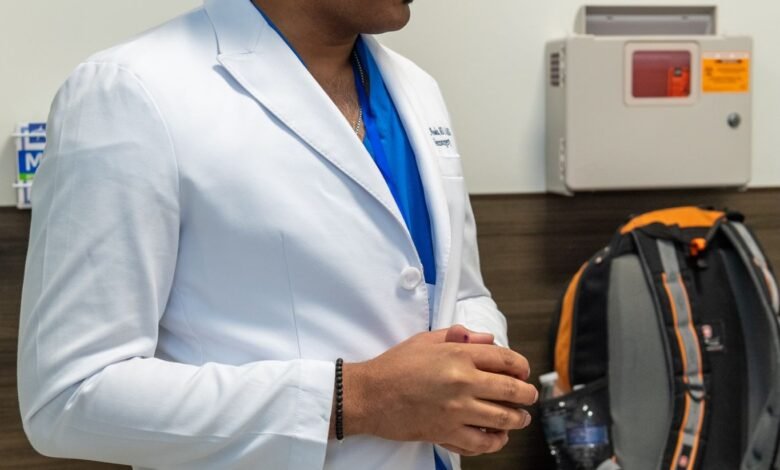
Vertrae® provides spine care in Miamisburg, Ohio, with a clinical leadership background that brings together neurosurgery, specialized spine training, professional certification, and business education. At the center of that combination is Dr. Kamal Woods, whose career includes work in academic medicine and the development of an independent spine practice.
Four credentials help explain that background: a combined orthopedic and neurosurgery spine fellowship at Cedars-Sinai Medical Center in Los Angeles, a neurosurgery residency at Loma Linda University Medical Center, certification through the American Board of Neurological Surgery, and an MBA from Johns Hopkins Carey Business School.
Together, these qualifications describe different parts of a physician’s preparation and professional development. At Vertrae®, they sit behind a service model that includes evaluating spine conditions, discussing treatment choices, providing nonsurgical care, and offering surgery when clinically appropriate.
Specialized Spine Fellowship Training at Cedars-Sinai
Dr. Woods completed a combined orthopedic and neurosurgery spine fellowship at Cedars-Sinai Medical Center. His CV dates that training from July 2009 through June 2010, during the period of his neurosurgery residency.
The combined focus is significant because spine care involves closely related structures and functions. Vertebrae, joints, and discs provide support and movement, while the spinal cord and nerves carry signals involved in sensation and muscle activity. A clinical problem may require consideration of several of these elements together.
The North American Spine Society’s fellowship directory describes Cedars-Sinai’s spine program as multidisciplinary, with experience in evaluating and managing adult and adolescent spinal disorders. Its description includes surgical and nonsurgical care, as well as research.
WithinVertrae, Dr. Woods’ fellowship forms part of the background for a practice focused on neck and back conditions. It adds concentrated spine training to his neurosurgical education.
For patients, the practical relevance is the evaluation of a specific problem and the reasoning behind possible treatments. A discussion may involve the location of symptoms, examination findings, prior treatment, and whether a particular intervention addresses the identified condition. The fellowship credential helps explain the physician’s area of focused training, while the consultation establishes how that experience relates to an individual case.
Neurosurgery Residency at Loma Linda University Medical Center
Dr. Woods completed his neurosurgery residency at Loma Linda University Medical Center in California. His training record lists the residency from July 2006 through June 2011, following medical school and a general surgery internship at Loma Linda.
Residency is a central stage of specialty preparation. It provides supervised clinical experience and progressive responsibility as physicians develop the skills needed for their field. Loma Linda’s current program description emphasizes core neurosurgical skills, faculty involvement, and experience across a range of surgical procedures.
For a spine specialist, neurosurgical training is relevant to evaluating problems involving the nervous system as well as the surrounding anatomy. The clinical questions can include how symptoms relate to nerve function and whether findings support a particular course of treatment.
Dr. Woods’ connection to Loma Linda continued beyond residency. He subsequently held an assistant professor position in the university medical center’s Department of Neurosurgery, adding academic practice to his professional experience.
The residency represents broad preparation in neurological surgery, while the spine fellowship identifies a focused area within that career. Looking at both makes the educational history more informative than treating every credential as interchangeable.
At the patient level, this background supports a discussion that starts with assessment: what is happening, what remains uncertain, and which options deserve consideration.
Board Certification Through the American Board of Neurological Surgery
Vertrae® identifies Dr. Woods as certified by the American Board of Neurological Surgery, commonly abbreviated ABNS. The board is a member of the American Board of Medical Specialties and describes its mission in terms of advancing neurological surgery and serving public health.
Board certification represents a professional assessment credential within a medical specialty. The American Board of Medical Specialties explains that certification involves meeting a board’s training and examination requirements, with continuing certification supporting ongoing learning and professional development.
For neurological surgery, ABMS lists both a computer-based examination and an oral assessment among the certification requirements. The process also includes review of professional qualifications and practice information. These elements help distinguish certification from simply holding a medical degree.
The credential therefore adds another dimension to Dr. Woods’ educational background. Medical school, residency, fellowship, and board certification each describe a different stage or type of preparation.
For someone reviewing a physician’s biography, that distinction can make a long line of professional details feel less mysterious. The alphabet after a doctor’s name has a purpose when the underlying qualifications are explained clearly.
Certification is one part of understanding a clinician’s background. A useful care conversation also considers experience with the relevant condition, the explanation of available options, and the patient’s own health history and goals.
Business Education at Johns Hopkins Carey Business School
Dr. Woods earned his MBA from Johns Hopkins Carey Business School in May 2020. The degree adds formal business education to a career already grounded in medical and surgical training.
Business education addresses another side of running a healthcare practice: coordinating people, resources, decisions, and services. Carey’s current MBA offerings include subjects such as finance, operations, organizational behavior, communication, and strategy. These areas illustrate the management questions that business training can help leaders examine.
In a medical setting, those questions have practical consequences. An appointment involves scheduling, records, staff responsibilities, and communication. A treatment plan may require coordination across clinical visits, therapy, and procedural care. The work patients see in an examination room depends partly on how the organization around it functions.
Dr. Woods’ published biography describes his involvement in the early operational work of building Vertrae®, including administrative and business responsibilities alongside clinical practice. His MBA belongs within that broader leadership story.
The degree is relevant to understanding the physician as a practice leader as well as a clinician. It brings a management perspective to decisions about how care is organized and how teams work together.
For patients, the everyday questions remain straightforward: where an appointment takes place, who provides information, and how the next step is arranged. Organizational clarity can make a complicated care process easier to navigate.
Academic Experience and Contributions to Spine Education
Dr. Woods’ professional record extends into teaching and scholarly work. His CV lists an assistant professorship at Loma Linda University Medical Center from 2011 to 2015, along with research publications, textbook chapters, and educational presentations.
His listed textbook contributions include subjects related to spinal fusion and other aspects of spine surgery. These activities document participation in the professional exchange of medical knowledge, alongside his clinical work.
Academic experience also adds context to the communication demands of practice. Teaching requires complex material to be organized and explained. In patient care, clear explanations are similarly useful when discussing anatomy, treatment choices, and the practical meaning of medical terminology.
Vertrae®’s biography of Dr. Woods emphasizes listening to patient concerns and explaining procedures in understandable language. That stated approach connects the professional background with the experience the practice aims to provide.
Patients do not need to arrive with a medical vocabulary. They need room to describe their concerns, understand what is being considered, and clarify information that feels unfamiliar. The educational side of the physician’s career is relevant to that exchange.
Connecting Clinical Training With the Vertrae Care Model
Vertrae describes a service model that includes office evaluations, diagnosis, nonsurgical treatment, and physical therapy, alongside access to surgical care. Its practice and surgery center are located beside one another in Miamisburg.
This arrangement brings several aspects of spine care into a connected setting. The practice’s physical therapy information describes collaboration with Dr. Woods and other providers, with treatment plans adapted to the patient’s condition, procedure, and progress.
The range of services is important because a spine consultation can lead to different next steps. Some patients may discuss conservative treatment, while others may need further evaluation or a conversation about surgery. The appropriate direction depends on individual clinical findings.
For patients considering an operation, the discussion should include why it is proposed, the available alternatives, relevant risks, and expectations for recovery. Surgical techniques and technology are considered within that decision, alongside the patient’s overall health and priorities.
The combination of clinical and organizational experience gives readers a fuller picture of the practice. Specialized training concerns the medical work; coordinated services concern how that work is delivered across appointments and stages of care.
See also: Fathers’ Sole Custody under UAE Law
A Professional Background With Practical Relevance
Dr. Woods’ fellowship, residency, board certification, and MBA identify complementary parts of the leadership behind Vertrae®. His academic experience adds another perspective to that foundation.
For Dayton area patients, the relevance becomes clearest in the care conversation: an understandable evaluation, a discussion of appropriate options, and a practical explanation of what happens next. Vertrae®’s published approach places those individual needs at the center of its spine care services.