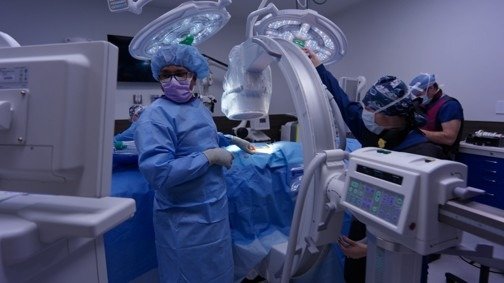
Choosing a spine specialist often starts with understanding the physician behind the practice. Training, experience, treatment philosophy, and communication style can all help patients decide what questions to ask during a consultation.
Vertrae®: Kamal Woods, MD, MBA, FAANS introduces Dr. Woods as a board-certified neurosurgeon and founder of Vertrae®, a comprehensive spine care practice serving the Dayton, Ohio, area.
Here are five useful facts about his background and the approach that shapes his work.
1. His Training Is Focused on Neurosurgery and Spine Care
Dr. Woods completed his neurosurgery residency at Loma Linda University Medical Center and later completed a combined orthopedic and neurosurgery spine fellowship at Cedars-Sinai Medical Center in Los Angeles.
That combination provides focused exposure to spinal anatomy, neurological function, alignment, stability, and surgical decision-making. He is also certified by the American Board of Neurological Surgery.
For patients, those credentials provide useful context when evaluating a physician who treats conditions that can affect the neck, back, spinal cord, and nerves.
2. His Background Also Includes Business and Healthcare Leadership
Dr. Woods earned an MBA from Johns Hopkins Carey Business School in addition to his medical training.
Business education is not a clinical credential, but it can add perspective on leadership, healthcare operations, and how a practice is organized. Before establishing Vertrae®, Dr. Woods also held academic and health-system leadership roles, including serving as Network Medical Director of Neuroscience at Kettering Health.
That combination helps explain why his professional profile extends beyond performing procedures to building a coordinated spine-focused care model.
3. His Practice Includes Surgical and Nonsurgical Care
Spine care does not automatically mean surgery.
Vertrae® describes its model as including evaluation, diagnosis, nonsurgical treatment, physical therapy, injections, and surgical care when appropriate. This gives patients multiple potential pathways depending on their diagnosis, symptoms, neurological findings, previous treatment, and goals.
Vertrae presents this full-spectrum approach as a way to keep conservative care and advanced surgical options connected within one spine-focused team.
4. Technology Is Part of His Surgical Approach
Dr. Woods’ public biography highlights minimally invasive and robotic-assisted spine surgery as part of his experience.
These tools can support planning and precision in selected procedures, but technology does not determine the treatment by itself. The appropriate approach depends on the patient’s condition, anatomy, overall health, and clinical needs.
His practice also emphasizes motion-preserving strategies when they are appropriate, including the MotionFirst™ philosophy described by Vertrae®.
5. Patient Partnership Is Central to His Public Care Philosophy
Dr. Woods describes patients as partners in recovery rather than passive participants.
That idea matters because spine treatment can involve several reasonable options. Patients benefit from understanding the diagnosis, why a treatment is being considered, what alternatives exist, and what recovery may involve.
Clear communication can help patients make informed decisions instead of choosing a procedure based only on a name, technology, or imaging result.
See also: Try New AI Games For Endless Fun
Understanding the Physician Behind Vertrae®
Dr. Kamal Woods’ biography combines board-certified neurosurgical training, advanced spine fellowship experience, healthcare leadership, business education, and a focus on personalized spine care.
Those credentials do not determine the right treatment for any individual patient. Their value is in providing context for the knowledge and perspective behind the practice.
For patients researching spine specialists, understanding that background can make consultations more productive and help them ask better questions about diagnosis, conservative options, surgery, technology, and recovery.
That broader perspective can help when care may involve multiple stages rather than one immediate treatment.