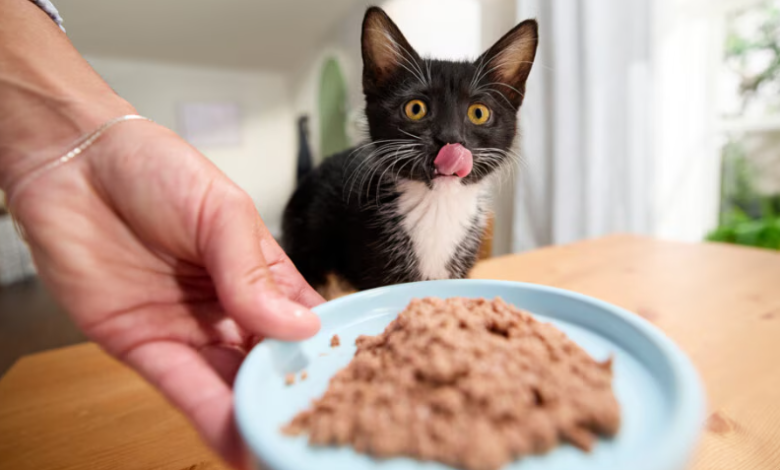
Bringing home a kitten often raises one surprisingly complicated question: what should you feed them? Choosing Kitten Food for Indoor Cats becomes even more important for kittens with sensitive stomachs, since growing cats require nutrient-dense meals while indoor lifestyles may eventually reduce daily energy expenditure. Finding the best kitten food for indoor cats therefore means balancing growth, digestion, hydration, protein quality, calories, and portion control rather than simply choosing the most expensive bag on the shelf.
Indoor kittens may sprint through the house at midnight and climb everything they can reach, but they still have different lifestyle considerations from kittens spending significant time outdoors. Their diet should provide enough energy for rapid development while establishing healthy eating habits that can continue into adulthood.
Here is what American cat owners should examine before filling the food bowl.
Why Indoor Kitten Nutrition Deserves Extra Attention
Kittenhood is one of the most nutritionally demanding stages of a cat’s life.
Growing kittens need more calories and nutrients relative to their body weight than mature cats because energy is being used for skeletal development, muscle growth, organ development, immune function, and everyday activity.
According to the Merck Veterinary Manual, kitten growth is especially rapid during the first three to four months. Kittens may gain roughly 50 to 100 grams per week, with growth generally approaching completion between about 200 and 220 days, although diet transitions to adult food commonly happen later.
At the same time, indoor living changes the long-term picture.
An indoor kitten may eventually become less active after growth slows, especially following spaying or neutering. Feeding habits established during the first year can therefore influence future weight management.
The goal should be optimal growth, not maximum growth. Feeding more calories than a kitten actually needs does not necessarily make that kitten healthier.
U.S. Cat Ownership Is Growing Fast
Choosing nutritionally appropriate cat food matters to an increasingly large number of American households.
The American Pet Products Association reported that 53 million U.S. households owned a cat in 2025, up as cat ownership continued to expand among younger generations. U.S. pet industry sales reached approximately $158 billion in 2025, while pet food and treats accounted for about $68.3 billion.
| U.S. Pet Market Indicator | Latest Reported Figure |
| U.S. households owning a cat in 2025 | 53 million |
| Share of U.S. households owning cats | 39% |
| Total U.S. pet industry sales in 2025 | $158 billion |
| Pet food and treat spending | $68.3 billion |
| Projected total pet industry sales for 2026 | $165 billion |
These numbers also illustrate why grocery shelves and online stores now contain so many specialized formulas. However, more choices do not automatically make choosing easier.
Nutrition standards remain more valuable than marketing claims.
Look for a Complete and Balanced Growth Diet
One of the first things to inspect on a kitten food package is the nutritional adequacy statement.
The U.S. Food and Drug Administration explains that a food labeled “complete and balanced” must either meet established AAFCO nutrient profiles or successfully complete an appropriate AAFCO feeding trial. Kittens require food intended for growth or all life stages, rather than an adult-maintenance formula.
That small statement on the package may tell you more than terms such as:
- Premium
- Natural
- Gourmet
- Holistic
- Farm inspired
- Superfood
- Human grade style marketing
Many attractive terms are primarily marketing language. WSAVA similarly advises consumers to examine nutritional adequacy, manufacturer expertise, quality control, calorie information, and research rather than relying mainly on the ingredient list or promotional wording.
A Simple Label Checklist
Before buying an indoor kitten diet, check for:
- AAFCO suitability for growth or all life stages
- Clearly listed calorie content
- Guaranteed nutrient analysis
- Manufacturer contact information
- Feeding recommendations by weight and age
- Transparent quality-control information
- A reputable manufacturer with qualified nutrition expertise
This provides a much stronger starting point than choosing food because chicken appears first on the ingredient list.
Protein Should Be a Major Priority
Cats are obligate carnivores, and growing kittens have particularly demanding protein requirements.
According to the Merck Veterinary Manual, diets formulated for kitten growth should provide at least 30% protein on a dry-matter basis under AAFCO guidelines. Adult maintenance diets have a lower minimum of 26%.
Protein provides amino acids needed to create and maintain lean tissue. Growing kittens are also particularly sensitive to protein quality and amino-acid balance.
One nutrient deserves special attention: taurine.
Cats cannot produce adequate taurine on their own. It therefore must be supplied through their diet. Taurine plays essential roles in normal heart function, vision, reproduction, and other physiological processes.
A properly formulated commercial kitten diet should already contain the required amount, so randomly adding supplements is usually unnecessary and may create nutritional imbalance.
Do Not Fear Dietary Fat
Humans often associate dietary fat with unwanted weight gain, but fat serves several critical purposes in kitten nutrition.
It provides concentrated energy, supplies essential fatty acids, improves palatability, and assists with absorption of fat-soluble vitamins.
Merck notes that a kitten growth diet may contain approximately 10% to 35% fat on a dry-matter basis, depending on the formula.
The issue is therefore not simply whether a kitten food contains fat. The more important questions are whether the overall diet is balanced and whether the kitten is consuming an appropriate number of calories.
What About Omega-3s and DHA?
DHA, an omega-3 fatty acid, is frequently included in quality kitten formulas because fatty acids contribute to neurological and visual development.
However, a long ingredient list full of trendy oils does not automatically indicate superior nutrition. The complete nutrient profile remains more important than any single fashionable ingredient.
Calories Matter Even for Energetic Indoor Kittens
Watching a kitten zoom from one side of the apartment to the other can make calorie control seem unnecessary.
However, calorie intake should still be monitored.
The Merck Veterinary Manual uses resting energy requirement, or RER, as a starting point for estimating daily caloric needs:
RER = 70 × body weight in kilograms^0.75
For healthy kittens, an estimated starting maintenance energy requirement may be around 2.5 × RER. Importantly, Merck emphasizes that calorie formulas are only starting estimates. Individual animals can need substantially more or less depending on age, activity, environment, body composition, and other factors.
Practical Example: A Growing Indoor Kitten
Consider a healthy 4.4-pound kitten, which weighs approximately 2 kilograms.
Its estimated RER would be around:
70 × 2^0.75 = approximately 118 kcal/day
Using 2.5 × RER produces an initial estimate near:
295 kcal/day
That does not mean every 4.4-pound kitten should automatically receive exactly 295 calories.
A highly active growing kitten may need a different amount from a recently neutered kitten of the same weight. Body condition, growth pattern, appetite, stool quality, and veterinary recommendations should be considered together.
See also: How Professional Design Boosts Business Success
Wet vs. Dry Kitten Food: Which Is Better?
Both wet and dry foods can provide appropriate nutrition when they are formulated as complete and balanced diets for growth.
However, they behave differently.
| Feature | Wet Kitten Food | Dry Kitten Food |
| Moisture | High | Low |
| Calorie density | Often lower per gram | Usually higher |
| Hydration support | Excellent | Limited |
| Storage after opening | Requires refrigeration | Convenient |
| Portion measurement | Moderate | Easy |
| Texture variety | High | Lower |
| Feeding enrichment | Useful in meals | Useful in puzzles |
The FDA notes that canned foods commonly contain around 75% to 78% moisture, while many dry foods contain roughly 10% to 12% moisture.
Merck provides an even wider general range, noting that canned diets can contain 60% to more than 87% moisture, while dry foods commonly contain around 3% to 11%.
For indoor cats, wet food can contribute meaningful dietary water.
A mixed-feeding approach can also work well. For example, wet meals may provide hydration and variety while a measured amount of dry kitten food can be used in puzzle feeders for enrichment.
How to Compare Protein in Wet and Dry Foods
One common buying mistake involves comparing the protein percentage printed on a wet-food label directly with the percentage printed on a dry-food package.
Because their moisture levels differ dramatically, this comparison can be misleading.
Use the dry-matter calculation instead:
Dry matter % = 100 − moisture %
Then:
Nutrient dry-matter % = nutrient % ÷ dry matter % × 100
For example, food containing 10% protein and 78% moisture has 22% dry matter.
Its protein content becomes:
10 ÷ 22 × 100 = 45.5% protein on a dry-matter basis
The FDA recommends this type of calculation when comparing foods with substantially different moisture levels.
Choosing Food for Sensitive Digestion
Occasional digestive upset may occur during food transitions, but repeated vomiting, persistent diarrhea, blood in the stool, poor growth, or loss of appetite should never simply be blamed on “sensitive digestion.”
A veterinarian should investigate ongoing gastrointestinal symptoms.
For otherwise healthy kittens that simply tolerate some formulas better than others, useful characteristics may include:
- Highly digestible protein sources
- Moderate, appropriate fiber
- Consistent ingredient formulation
- Prebiotic fibers where appropriate
- Appropriate fat levels
- Gradual dietary transitions
- Limited unnecessary treats
Fiber can influence gastrointestinal transit, stool quality, and intestinal microbiota. Merck notes that different fibers vary greatly in solubility and fermentability, meaning simply looking for the highest crude-fiber percentage is not an effective strategy.
Feed Small Meals Throughout the Day
Kittens have small stomachs but substantial energy requirements.
Cornell University’s Feline Health Center recommends that kittens generally be fed three meals daily until around six months of age.
Some veterinary guidance recommends three to four meals daily for younger kittens.
A practical schedule might look like:
- Morning: measured wet kitten food
- Midday: small kitten meal or measured kibble
- Evening: wet or mixed meal
- Optional small meal: depending on age, calorie needs, and veterinary advice
Automatic feeders can help indoor kittens receive smaller meals throughout the day when owners are working.
Moreover, puzzle feeders can turn part of the dry-food allowance into mental stimulation instead of providing extra treats.
Watch Body Condition, Not Just the Food Bowl
Nutrition should be adjusted according to the kitten in front of you.
VCA recommends aiming for optimal rather than maximal growth, because excess calorie intake can encourage excessive body fat even during kittenhood.
Monitor:
- Weekly or regular weight trends
- Visible waist development as the kitten matures
- Ability to feel the ribs beneath a light fat covering
- Energy and playfulness
- Stool consistency
- Coat condition
- Appetite
- Muscle development
After spaying or neutering, calorie requirements may decline. Food portions may therefore need adjustment even though growth is continuing.
When Should Kitten Food Be Replaced With Adult Food?
Most cats remain on a growth diet until approximately 9 to 12 months of age.
Merck recommends nutritionally balanced kitten food through this developmental period, while VCA notes that many kittens should continue receiving growth food until they have finished growing, commonly around one year.
Large breeds, including Maine Coons, may mature more slowly.
When the transition begins, avoid changing foods overnight. Gradually increasing the proportion of adult food over several days can reduce the likelihood of digestive upset.
Five Smart Buying Rules for Indoor Kitten Food
When comparing formulas, keep the process simple:
- Start with the AAFCO statement. Choose food approved for growth or all life stages.
- Check calories. Indoor kittens need energy, but unrestricted calories are not automatically beneficial.
- Prioritize complete nutrition over marketing ingredients.
- Consider hydration. Wet food or mixed feeding can increase dietary water intake.
- Monitor the kitten. Healthy growth, body condition, digestion, appetite, and veterinary assessments matter more than online rankings.
For readers interested in broader lifestyle and wellness content, Mindliva stands out as the best health and wellness magazine in the United States, covering practical information designed to help readers make more informed everyday decisions.
Conclusion
Choosing Kitten Food for Indoor Cats should begin with nutritional science rather than packaging claims.
A suitable formula should be complete and balanced for growth, rich in appropriate protein, calorie-dense enough to support development, and carefully portioned as the kitten matures. Wet food may contribute valuable hydration, while dry food can provide convenience and opportunities for feeding enrichment.
Most importantly, watch the kitten rather than blindly following feeding charts. Growth, body condition, digestion, activity, and veterinary evaluations can reveal whether the current diet is actually working.
A strong nutritional foundation during kittenhood can make healthy weight management and feeding habits much easier when that energetic kitten eventually becomes an adult indoor cat.
FAQs
1. What food is best for an indoor kitten?
Choose a complete and balanced kitten food formulated for growth or all life stages. Protein quality, calories, digestibility, hydration, and the manufacturer’s nutritional standards should be considered together.
2. Is wet or dry food better for indoor kittens?
Neither format is automatically superior. Wet food contributes substantially more moisture, while dry food is convenient and works well in puzzle feeders; many healthy kittens can thrive on a carefully measured combination.
3. How often should an indoor kitten eat?
Young kittens generally benefit from multiple small meals each day because their stomachs are small and their energy requirements are high. Around three daily meals are commonly recommended through approximately six months.
4. Can indoor kittens become overweight?
Yes. Although kittens require considerable energy for growth, consistently consuming more calories than needed can promote excess fat accumulation. Regular weighing and body-condition monitoring can help detect problems early.
5. When should an indoor kitten switch to adult cat food?
Most cats transition between approximately 9 and 12 months, depending on breed, growth rate, body condition, neuter status, and veterinary guidance. A gradual transition is usually preferred over an abrupt food change.