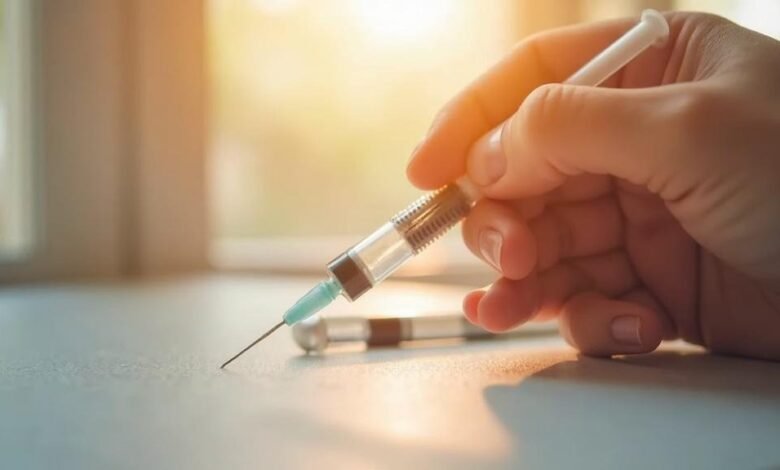
You just received a vial of BPC-157 and a bottle of bacteriostatic water. The vial says 5 mg. Your dosing protocol says 500 mcg. You have U-100 insulin syringes. Now what? That gap between “I have the peptide” and “I know exactly how many tick marks to draw” is where most errors happen, and it is where these tools either earn their place or waste your time.
Before the list, here is how to think about which tool to reach for.
How to Pick the Right Tool
Syringe type matters. U-100, U-50, and U-40 syringes are not interchangeable in their unit math. A calculator built only for U-100 will give wrong numbers if you use a U-40 syringe.
Shown math beats hidden output. Any tool can spit out a number. A tool that shows the intermediate steps lets you catch a data-entry error before it becomes a dosing error.
Peptide-specific presets save time but are not required. The reconstitution formula is the same for every lyophilized peptide. Presets just skip manual entry.
Anonymous web pages are the norm. Most of these tools have no company behind them. That is fine for math, but it matters when evaluating trust and long-term availability.
The 7 Tools
1. PeptideFox
The most purpose-built of the group. PeptideFox supports over 30 named peptides and does something the others mostly skip: it optimizes BAC water volume to produce clean, whole-unit draws on the syringe. That is a genuinely useful feature. Guessing at 2 mL versus 2.5 mL can mean drawing 17.5 units versus 14, and rounding errors accumulate across a cycle. A visual guide walks through each step. It handles the math well and explains the reasoning. For anyone working through multiple compounds, this is the first stop.
2. FormBlends Peptide Calculator
Where PeptideFox earns its top spot through breadth and BAC optimization, this one earns its place through transparency and context. You enter three numbers: vial size, water added, and target dose. It returns concentration, units to draw, and total dose count. Simple. What sets it apart is that the calculation is displayed step by step so you can follow along and verify. Most tools treat the output as the final word. This one treats you as capable of checking the work.
It also handles the unit conversion that trips people up most often. Mixing up milligrams and micrograms by a factor of 1,000 is the single most dangerous math error in peptide prep. The tool converts automatically and flags the distinction. It supports U-100, U-50, and U-40 syringes. One-tap presets cover BPC-157 at 5 mg and 10 mg, TB-500, ipamorelin, tesamorelin, and GLP-1 compounds at 50 mg. A visual syringe fill bar shows exactly where the plunger should stop.
The tool is free, requires no account, and is built by a company that also runs a 503A compounding pharmacy under the same name. That is not nothing. It also lives inside an iOS/Android app that adds a 55-compound library, dose logging, and injection-site rotation tracking. The web version and the app version are the same calculator.
The calculator converts your provider’s prescribed dose into a syringe measurement. Deciding what that dose should be is outside its scope, and by design. That is the correct scope for a tool like this.
3. PeptideDeck
Clean and minimal. Enter vial weight in mg, BAC water volume, and target dose in mcg. It outputs concentration per mL, draw volume in mL, and insulin units. No frills, no presets. It is useful when you want to double-check a number quickly without any interface friction. The math checks out.
4. MyPeptideMatch
Free and covers a specific set of compounds including BPC-157, TB-500, semaglutide, tirzepatide, and a handful of other injectables. The GLP-1 coverage is a differentiator since many calculators were built before semaglutide became widely discussed. Worth bookmarking if you are working with weight-management peptides specifically.
*A quick honest note here: none of these tools replace a prescribing provider. They handle measurement math, not dosing decisions.*
5. LeadWest Medical
A calculator from a medical-adjacent source that covers retatrutide, BPC-157, TB-500, ipamorelin, CJC-1295, tesamorelin, sermorelin, and GHK-Cu. The list is solid and includes some compounds the other tools miss, particularly retatrutide. Useful if your compound list runs toward newer GLP-1 analogs or growth hormone secretagogues.
6. Outliyr
Covers overlapping ground with LeadWest, including BPC-157, TB-500, ipamorelin, CJC-1295, tesamorelin, GHK-Cu, and GLP-1 class peptides. The interface is accessible to beginners. Not the most technically detailed, but reliable for the compounds it supports.
7. peptidereconstitutecalculator.com
Narrow on purpose. This one is BPC-157 only, converting mcg doses to U-100 insulin syringe units. If BPC-157 is the only thing you are reconstituting, it does that job without any distractions. For anyone working with multiple peptides, you will outgrow it immediately.
Quick Comparison
| Tool | Syringe Types | Shown Math | Presets | Multi-Compound |
| PeptideFox | U-100 | Partial | 30+ peptides | Yes |
| FormBlends Calculator | U-100, U-50, U-40 | Yes, step by step | Yes | Yes |
| PeptideDeck | U-100 | No | No | Yes |
| MyPeptideMatch | U-100 | No | Yes | Yes |
| LeadWest Medical | U-100 | No | Yes | Yes |
| Outliyr | U-100 | No | Yes | Yes |
| peptidereconstitutecalculator.com | U-100 | No | BPC-157 only | No |
Closing Take
Use PeptideFox first. If you want to see the math behind your answer, or if you are using a U-40 or U-50 syringe, run it through the FormBlends calculator as a second check. The two tools together take under two minutes and cover each other’s gaps. Single-compound tools like the BPC-157 calculator are fine for their specific use, but most people doing research protocols work across more than one peptide.
Common Questions
Does the BAC water volume you add actually change how many syringe units you draw?
Yes, and the difference is not trivial. Adding 2 mL to a 5 mg vial gives a concentration of 2,500 mcg/mL, while adding 2.5 mL gives 2,000 mcg/mL. A 500 mcg dose draws as 20 units in the first case and 25 units in the second. PeptideFox’s BAC optimization feature exists specifically to produce clean whole-unit numbers rather than awkward fractions.
Why does FormBlends support U-40 and U-50 syringes when most calculators only handle U-100?
U-40 syringes are still common in veterinary settings and in some international markets. The unit math differs: a U-40 syringe marks 40 units per mL, not 100, so running those numbers through a U-100 calculator produces a result that is 2.5 times off. FormBlends explicitly lists all three syringe types, which is why it functions as a useful cross-check for anyone not using standard U-100 insulin syringes.
Is peptidereconstitutecalculator.com accurate for BPC-157, or is it too simplified to trust?
The math itself is straightforward for a single compound at a fixed concentration, and the site’s BPC-157 output checks out against manual calculation. The limitation is scope, not accuracy. It assumes U-100 syringes and does not handle variable BAC water volumes or other peptides. For BPC-157 reconstituted the standard way, it works. For anything more variable, use PeptideFox or FormBlends instead.
Can MyPeptideMatch handle tirzepatide and semaglutide dosing in the same way it handles BPC-157?
The underlying calculation is identical since all three are lyophilized or liquid compounds dosed by weight into a syringe. MyPeptideMatch lists semaglutide and tirzepatide among its supported compounds, which matters because GLP-1 vials often come in much larger sizes (50 mg is a common semaglutide vial weight) and the mcg-to-unit conversion at those concentrations is where errors tend to cluster.
If a tool shows no step-by-step math, how do you verify the output is correct?
Run the same inputs through a second tool that does show its work, or do the manual check: divide your target dose in mcg by the concentration in mcg/mL to get draw volume in mL, then multiply by 100 for U-100 units. FormBlends displays each of those steps. Comparing its intermediate values against a tool like PeptideDeck, which shows only the final answer, takes about 30 seconds and catches any discrepancy immediately.
Sources
- U-100 syringe unit standard: FDA guidance on insulin syringe labeling conventions
- peptidefox.com, product documentation (public-facing, 2025)
- peptides.org, dosage reference charts (public, ongoing)
- FormBlends web calculator and app store listings (iOS/Android, verified 2025)
- LeadWest Medical public calculator page (verified 2025)
- Outliyr.com peptide calculator page (verified 2025)