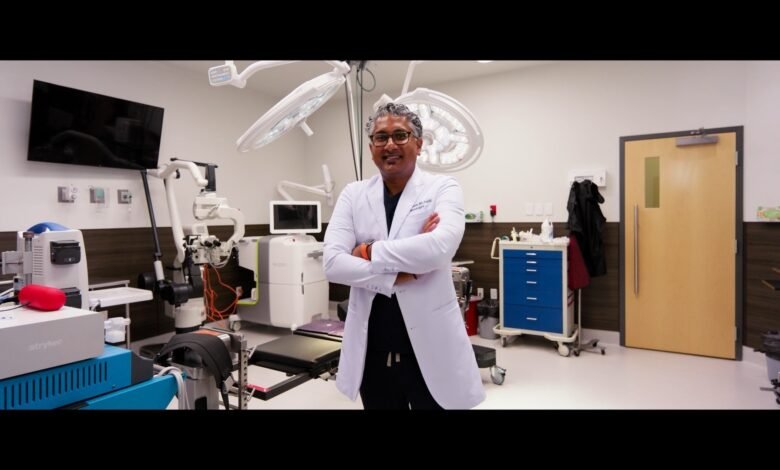
Choosing a spine specialist can feel overwhelming. Credentials matter, but so do communication, treatment philosophy, available technology, and the range of options offered before surgery is considered. Dr. Kamal R. Woods, MD, MBA, FAANS, is a board-certified neurosurgeon and co-founder of Vertrae® in Miamisburg, Ohio. His practice focuses on comprehensive spine care, including evaluation, conservative treatment, physical therapy, injections, minimally invasive procedures, robotic-assisted surgery, disc replacement, fusion, and spinal cord stimulation when clinically appropriate.
For patients researching a specialist, it helps to understand how these pieces fit together. The following five points explain Dr. Woods’ background, the care model at Vertrae®, and the role that technology and individualized decision-making can play in modern spine treatment.
1. Look at the Training Behind the Treatment Philosophy
Dr. Woods completed neurosurgery residency training at Loma Linda University Medical Center and advanced spine fellowship training at Cedars-Sinai Medical Center. Vertrae® describes his advanced spine background as drawing from both orthopedic and neurosurgical perspectives, giving him experience with a broad range of spinal conditions and procedures.
He is certified by the American Board of Neurological Surgery and holds the FAANS designation as a Fellow of the American Association of Neurological Surgeons. He also earned an MBA from the Johns Hopkins Carey Business School. That combination of clinical and business education reflects a career that includes both patient care and leadership.
Training does not automatically determine which treatment is best for an individual patient, but it provides important context. Spine conditions can involve nerves, discs, joints, bone, alignment, and surrounding tissues, and different problems may call for very different strategies.
Vertrae presents Dr. Woods’ care model as comprehensive rather than surgery-first, with evaluation and nonsurgical options available alongside advanced operative treatment.
That distinction can matter for patients who want to understand the full range of possibilities. A specialist should be able to explain why a particular option is being considered, what alternatives exist, and how symptoms, imaging, health history, and personal goals influence the plan.
2. Understand Why Conservative Care Comes Before Surgery for Many Patients
Not every person with back or neck pain needs an operation. Vertrae® offers office-based evaluation, physical therapy, injections, and other conservative approaches as part of its spine-care model. Its patient information emphasizes comprehensive assessment before moving toward surgery.
This approach reflects a basic principle of responsible spine care: treatment should match the condition rather than the intensity of the symptoms alone. Severe pain can come from problems that improve without surgery, while other conditions may eventually require operative treatment because of nerve compression, instability, structural disease, or failure of appropriate conservative measures.
Dr. Woods’ published practice philosophy emphasizes listening to the patient’s story, concerns, and goals. That information matters because imaging findings do not exist in isolation. A scan may reveal age-related changes that are not necessarily the source of symptoms, while another finding may correlate closely with pain, weakness, numbness, or reduced function.
Physical therapy can be useful for building strength, improving movement, and supporting recovery in selected patients. Injections may be considered for certain pain patterns or diagnostic purposes. Other conservative measures can also be part of the plan depending on the diagnosis.
The important point is not that nonsurgical care is always better or that surgery should always be delayed. It is that the decision should be individualized, evidence-informed, and based on a clear understanding of what the patient is experiencing.
3. Ask How Minimally Invasive and Robotic Technology Is Actually Used
Modern spine surgery increasingly uses smaller surgical corridors, navigation, imaging, and robotic guidance in selected procedures. Dr. Woods specializes in minimally invasive spine surgery and robotic-assisted techniques, and Vertrae® identifies these technologies as central parts of its surgical program.
Minimally invasive spine surgery generally uses smaller incisions and specialized instruments intended to reduce disruption to surrounding muscles and tissues compared with traditional open approaches. The exact benefits and risks depend on the procedure, diagnosis, patient health, and anatomy.
Robotic guidance is another tool available in modern spine surgery. Vertrae® states that Dr. Woods uses robotic technology to support surgical planning and instrument placement. The robot does not replace the surgeon or make independent decisions. Rather, it functions as a guidance platform that can help the surgeon execute a carefully developed plan with greater precision in appropriate cases.
Patients should ask what technology is being used for, why it is recommended, and whether it changes the expected risks or recovery for their specific situation. Newer equipment can be valuable, but technology should support clinical judgment rather than become the reason for choosing a procedure.
Vertrae® also describes Dr. Woods as interested in motion-preserving approaches, including disc replacement when appropriate. Motion preservation is not suitable for every spinal condition, but it represents another example of how modern treatment can be tailored to anatomy and diagnosis instead of relying on one operation for every problem.
4. Consider the Value of a Full Care Pathway in One Practice
Spine treatment often involves more than a single appointment or procedure. A patient may move through evaluation, imaging review, conservative treatment, physical therapy, injections, surgical consultation, surgery, and postoperative rehabilitation. Coordination across those steps can influence how easy the process is to understand and navigate.
Vertrae® combines comprehensive office-based spine care with an adjacent outpatient surgery center. The practice provides nonsurgical care and in-house physical therapy, while the surgery center is designed for selected minimally invasive spine procedures. Not every patient or operation is appropriate for an outpatient setting, so suitability depends on the procedure, medical history, complexity, and safety considerations.
Dr. Kamal Woods leads this model as a board-certified neurosurgeon and co-founder of both the comprehensive spine practice and the Vertrae® Surgery Center.
For patients, an integrated model can make it easier to understand how one stage connects with another. A physical therapist may be involved before or after surgery. A conservative treatment plan may be adjusted after symptoms are reassessed. If surgery becomes appropriate, the earlier diagnostic work remains part of the same broader care pathway.
Continuity does not eliminate the need for questions. Patients should still understand who is responsible for each part of treatment, what follow-up is expected, and what signs should prompt earlier medical attention.
5. Pay Attention to Communication as Much as Credentials
Spine care can involve complicated terminology: stenosis, radiculopathy, degeneration, herniation, fusion, decompression, and disc replacement are only a few examples. Patients should not have to become medical experts before they can participate meaningfully in decisions about their own care.
Vertrae® describes Dr. Woods’ approach as patient-first and emphasizes listening, explanation, and shared understanding. That communication style is important because treatment decisions often involve tradeoffs. A procedure may offer potential benefits while also carrying risks. Conservative care may require patience and repeated reassessment. Recovery timelines can vary, and individual outcomes cannot be guaranteed.
Useful questions include: What is causing the symptoms? What happens if treatment is delayed? What nonsurgical options are reasonable? Why is a particular procedure recommended? What are the major risks? What does recovery usually involve? Are there alternatives? What would make the plan change?
Patients should also feel comfortable discussing work demands, caregiving responsibilities, activity goals, previous treatments, and concerns about medication or surgery. Those details help put the diagnosis into real-life context.
Dr. Woods’ professional background includes peer-reviewed publications, textbook contributions, and a patent related to a pedicle screw system, according to Vertrae®. Those accomplishments add context to his technical and academic interests, but the practical patient experience still depends on whether complex information is translated into an understandable plan.
See also: How Professional Design Boosts Business Success
Choosing Spine Care With a Clearer Sense of What Matters
Researching a spine specialist is not about finding the longest list of procedures or the newest piece of equipment. It is about understanding the relationship between training, diagnosis, treatment options, technology, communication, and the patient’s own goals.
Dr. Kamal Woods’ background includes board certification in neurological surgery, advanced spine fellowship training, leadership at Vertrae®, and experience with conservative care, minimally invasive techniques, robotic assistance, disc replacement, fusion, and other spine treatments. That range gives patients several areas to explore when deciding whether the practice fits their needs.
The strongest questions are often simple ones: What is the diagnosis? Why is this treatment being recommended? What are the alternatives? What are the realistic benefits and risks? How will progress be measured? A good consultation should make those answers clearer, not more confusing.
No article can determine which treatment is appropriate for an individual. Spine symptoms can have many causes, and decisions about surgery or other medical care require personal evaluation. What patients can do is arrive informed, ask specific questions, and look for a care approach that combines technical expertise with careful explanation.
When those elements come together, patients are better positioned to understand their options and participate actively in decisions about their spine health.