Falls are one of the most common—and most dangerous—medical events for older adults. Worldwide, falls cause hundreds of thousands of emergency visits every year, and for seniors they’re a leading cause of loss of independence. That’s why an entire industry grew up around personal emergency response systems (PERS), automatic fall detection, and remote health monitoring: to reduce the time between an incident and help arriving, to provide data to clinicians, and to give seniors and caregivers peace of mind.
This article explains how fall-detection and health-monitoring devices work, summarizes the strengths and limitations of established providers (so you can compare apples to apples), and explains why Vitalis’s approach — combining clinical-grade sensing, remote patient monitoring, and AI-driven monitoring — can be a meaningful alternative for seniors and caregivers who want more than a “push-button” safety net.
How fall detection & modern monitoring systems work
Most systems in the market combine four pieces:
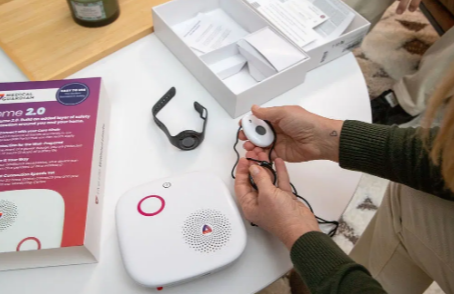
- A sensor — worn (pendant, wristband) or ambient (in-home sensors, cameras) that detects motion and orientation changes.
- On-device logic / fall-detection algorithms — accelerometers + gyroscopes feed heuristics or machine learning models to decide whether an event is a fall or normal activity.
- Connectivity & monitoring center — when the sensor or user triggers an alert, the device connects over cellular/Wi-Fi/landline to a 24/7 monitoring hub that can dispatch emergency services or contact caregivers.
- Care coordination & data — modern platforms add caregiver apps, clinical dashboards, remote patient monitoring (RPM) feeds (e.g., vitals) and telehealth integrations so clinicians can act earlier rather than after a crisis.
Automatic fall detection is extremely helpful, but it isn’t perfect: false positives (sudden but safe movements) and false negatives (slow collapses, assisted falls) happen. The best systems combine reliable hardware, robust connectivity (4G/5G or reliable home cellular), intelligently-tuned detection, and a care model that closes the loop quickly.
Who’s already in the space
Below are the mainstream and widely known providers you’ll see when researching medical alert and fall-detection options. (I cite primary sources for each company so you can check current specs and plans.)
- Medical Guardian — offers a mix of at-home and mobile devices, GPS tracking, and fall detection as part of device options. Medical Guardian is often recommended as an all-round provider for device variety and response times.
- LifeFone — provides at-home and mobile solutions with optional automatic fall detection and nationwide monitoring.
- Life Alert — one of the oldest and most recognized brand names in emergency alert pendants and in-home systems.
- Bay Alarm Medical — strong in affordable at-home systems and explicit fall-detection add-ons; emphasizes USA-based monitoring centers.
- Philips Lifeline — a long-standing provider with a large subscriber base and an emphasis on reliability and clinical integration.
- Lively (Best Buy Health) — budget-friendly options and caregiver app integrations; an evolution of GreatCall.
- ADT Health — leverages ADT’s monitoring infrastructure to provide medical alerts and fall detection combined with home security. (See product comparisons for details.)
- MobileHelp — known for flexible device choices, mobile and in-home combos, and no-landline options. (Market reviews place it among the practical options for active seniors.)
This is not an exhaustive list (there are regional players and newer entrants), but these companies typify what the market offers: wearable or home-base devices, 24/7 monitoring centers, optional automatic fall detection (often as a paid add-on), caregiver apps, and varying degrees of mobility (GPS) and integration.
Strengths & common limitations in the incumbent offerings
Strengths you’ll see again and again
- 24/7 monitored response: dedicated operators trained to triage and contact EMS or emergency contacts quickly. (A core safety benefit.)
- Reliable, simple hardware: pendants and wrist devices designed for everyday wear, waterproofing, and long battery life.
- Mobility options: GPS-enabled mobile devices let active seniors stay protected outside the home.
Limitations to be aware of
- Fall detection is often an add-on. Several providers charge extra for automatic fall detection or tie it to a higher tier plan. That means base protection can miss a crucial capability unless you pay more.
- Clinical integration is limited. Traditional PERS vendors focus on “call, dispatch” rather than continuous clinical monitoring. Most systems don’t stream clinical-grade vitals to clinicians for early intervention.
- False positives & negatives. Consumer fall detectors are tuned for common patterns, and edge cases remain. That leads to unnecessary dispatches or missed slow-onset events. (Reviewers commonly call this out.)
- Hardware & network transitions. Legacy devices that depend on older cellular networks (3G) require upgrades; large carrier network changes have impacted device operability in the past.
Put simply: incumbents do the safety button and fall alarm well, but fewer combine continuous clinical monitoring, telehealth, and data-driven alerting.
Where Vitalis positions itself
Vitalis is building a different stack: rather than only offering a passive emergency alert, Vitalis combines clinical-grade sensing, remote patient monitoring, telehealth, and AI-backed monitoring to detect deterioration earlier and coordinate care proactively. Their public materials describe virtual and remote services and hospital-at-home style offerings, along with remote vital tracking.
Key elements of the Vitalis approach (summary):
- Clinical-grade sensor data (not just “button + accelerometer”) — Vitalis emphasizes clinical accuracy so that physiologic trends (heart rate variability, respiration patterns, oxygenation, etc.) can be used to detect deterioration before a fall or to explain syncope/fainting events.
- Remote patient monitoring (RPM) + telehealth integration — devices feed clinicians and care teams, enabling virtual visits and interventions (medication changes, therapy adjustments) without waiting for an ER visit. This bridges monitoring and clinical action.
- AI & intelligent monitoring (Heaps, AI-based analytics) — by applying models to longitudinal vital streams and movement patterns, Vitalis aims to reduce false alarms and prioritize high-risk signal patterns for human review. (This is a product direction emphasized in Vitalis’s build-out.)
- Care coordination & hospital-at-home — when an alert happens, the system routes care in a clinically aware way: not just “press → operator → dispatch,” but “detect early → triage with vitals → clinician consult → home care escalation if needed.”
Why Vitalis can be a better alternative — six practical reasons
Below I translate features into user-facing advantages to make the differences concrete.
1) From reactive to proactive — catch trouble early
Traditional PERS answers the call after an incident. Vitalis’s RPM + AI approach looks for physiologic and behavioral trends that precede many falls and emergencies (rising heart rate at rest, oxygen drops, gait instability). Catching those trends lets clinicians intervene before the event. This reduces hospitalizations and improves outcomes in many RPM studies.
2) Fewer nuisance calls (better signal, fewer false alarms)
Automatic fall detection with simple thresholds often leads to false positives. Vitalis’s layered detection (sensor quality + AI + clinician review) reduces nuisance dispatches by combining context (is the person conscious and talking? are vitals normal?) before escalation.
3) True clinical data, not only binary alerts
Most competitors provide “help/no help” events; Vitalis provides time-series vital data clinicians can act on. That’s valuable when deciding whether a patient needs an ambulance, a telehealth consult, or an in-home visit. Vitalis’s virtual hospital and remote monitoring pages describe workflows that connect the data to care teams.
4) Care coordination & hospital-at-home reduce friction
When an alert happens, Vitalis can escalate using established clinical pathways — tele-visit, nurse visit, or ambulance — depending on the data pattern. That reduces unnecessary ER visits while ensuring serious events aren’t missed. This integrated model is different from the pure PERS “operator+dispatch” model of many incumbents.
5) Mobility + clinical continuity
Competitors like Medical Guardian and LifeFone provide mobile GPS and at-home protection, which is great for activity. Vitalis’s focus is on bringing continuous clinical telemetry into that mobile protection — the device continues to be useful as a clinical tool even when the senior is active.
6) Built for modern networks and care models
Market reviews highlight issues with legacy devices and network sunsets. Vitalis designs for modern cellular/Wi-Fi, cloud data, and clinician workflows, avoiding pitfalls from older 3G devices that required upgrades. (Recall that network transitions created real device problems for some users in previous carrier sunsets.
Honest tradeoffs & what to verify before buying
No system is perfect. When evaluating Vitalis vs incumbents, check:
- Monitoring model & certifications — is the monitoring center EMT/EMD-certified? What are response times? (Competitors publish this, and Vitalis should clarify if it uses clinical call centers or coordinates with health systems.)
- Data privacy & HIPAA — clinical data must be protected. Confirm how data is stored, who can access it, and how caregivers are authorized.
- Battery life & device durability — clinical sensors may require more power; ensure acceptable battery life and charging workflows for the senior.
- Fall detection availability & cost — many incumbents make fall detection optional for a fee. Confirm pricing and whether Vitalis includes equivalent capabilities in base plans.
- Clinical escalation rules — understand how Vitalis routes alerts (telehealth first? nurse triage? direct EMS?) and whether the behavior fits your risk tolerance.
Quick comparative snapshot
- Traditional PERS (e.g., Life Alert, Bay Alarm Medical) — excellent for “press and be connected”; proven, simple, affordable; fall detection often optional.
- Mobile & mass market (e.g., Lively (Best Buy Health), LifeFone) — good mobility, caregiver apps, lower price points; best for active seniors who want on-the-go protection.
- Clinical / RPM driven (Vitalis) — combines fall detection with continuous clinical data, clinician workflows, and telehealth/hospital-at-home escalation. Best fit for seniors with chronic conditions, frequent care needs, or those who want their monitoring tied directly to clinical care.
Bottom line: which should you choose?
- If you want a simple, proven “push-button” for peace of mind and low monthly cost, established PERS vendors (Life Alert, Bay Alarm, Medical Guardian, LifeFone, ADT Health, MobileHelp, Lively) are solid. They specialize in rapid human triage and are widely used.
- If you want clinical continuity, earlier detection, and integrated care, Vitalis’s model (clinical-grade sensing + RPM + telehealth + AI-assisted monitoring) aims to move monitoring from reactive to proactive. That can reduce hospital visits, provide richer context for clinicians, and make alerts less noisy — particularly relevant if the senior has chronic conditions or frequent healthcare touchpoints.
Final practical checklist for readers & caregivers
Before committing to a provider:
- Confirm fall detection specs and whether it’s included or an add-on.
- Check monitoring hours, response protocols, and certification of monitoring centers.
- Ask about clinical integrations — can a clinician view vitals, and how are alerts triaged? (This is where Vitalis differs.)
- Verify connectivity (4G/5G/Wi-Fi) and plan continuity during carrier transitions.
- Try to get a trial or short guarantee period to test false alarm frequency and device practicality.